Sunday, October 23, 2011

Conferences, comics and politics

Okay. I’ll admit it. I’ve been neglecting this blog like it was a pile of dirty dishes. A lot of exciting things have happened in the comics world (to me, at least), so I’ll discuss them in order:


Dibujados:

Dibujados was an enjoyable event, mainly because it was filled with lots of comics and people I like. It was held in a hostel and was set up really well for selling, mingling and signing, but not for the lecture series it hosted.* The lectures were given in an open hall and there were a lot of people talking in the background, so I couldn’t hear much. In terms of my Spanish skills, I still haven’t mastered the ability to understand fragments of lectures. (I am proud to say that I am getting better at overhearing conversations. The other day I heard one street cleaner say to the other “He wanted women, but he could only find transvestite prostitutes.”) But I enjoyed the event because I bought a bunch of comics and saw my friends, so I give it four stars.


University of Palermo’s “9º Jornadas de Diseño de Historietas:”

The Jornada offered a series of lectures that dealt from all points of view from the creation of a comic to its eventual sale as a book. You can see the impressive series of lectures here. I attended the second half to learn about the part of the comics creation process that I hadn’t learned about through my interviews, like the printing process, sales in comics stores and magazine topic selection.


Seminar paper for “Artes secuenciales:”

The theme for my paper for Laura’s class dealt with how the economy has an impact on the ability for comics artists to live off their work. I turned it in on Tuesday and met with Laura on Friday for my oral final. Overall, I really enjoyed the final product, though the process of writing a paper turned me into a lunatic. (Makes me wonder how I ever maintained friends in college while turning in a 10-page paper every month.) I got an 8 out of 10, a good grade considering the fact that I wrote it in Spanish. Hopefully, I will translate some of the content for my blog and eventually turn it into some sort of paper.


Interview with Andrés Valenzuela and article in Cuadritos:

Andrés Valenzuela, comics journalist and generally awesome person, interviewed me for his blog Cuadritos. We met in the most silent bar I’ve ever been to in Buenos Aires and talked for about 30 minutes. Fortunately, we did the interview in English, so I don't end up sounding like a raving idiot in the article. The paper I wrote for Laura’s class helped me organize my ideas, so that when I talked about my grant my proclamations were focused and clear, looking at the larger picture instead of a few small details. Anyway, if you want to read the interview, you can find it here: “Los últimos ocho años beneficiaron a la historieta argentina.” ("The last eight years have benefitted the Argentine comic") As the title implies, I talk about economic stability in Argentina during the last eight years. During the past eight years, both Nestor and Cristina Kirchner were in power. Coincidentally Argentina had elections today in which Cristina Kirchner won.


Anyway, next week I’m going to continue with interviews and transcribing. I will be publishing piece by piece an interview I did with Diego Agrimbau. And, most importantly, I'm going to find a costume for Halloween.


*I complain about space a lot in this blog. Maybe I’m anal retentive or excessively bothered by everything, but I think layout can make or break an event. And other people have commented similar ideas to me in interviews or personal conversations, so I’m not the only crazy one.

Tuesday, October 11, 2011

Paper, paper, paper

I just returned from a ten-day journey covering Córdoba and Paraná that was a mix of pleasure, investigation, and religious duty. Now I’m back and resting in Buenos Aires, writing a ten-page paper for Laura Vazquez’s class. Remember the seminar I took last semester? Well, in Argentina papers have a series of final dates during which you can submit them for grading and I’m turning mine in next week. My paper is generally about how the economic stability of the past few years has allowed people to have careers making comics, followed by a discussion of the characteristics of those careers. I’m a little bit nervous because my paper is based on part of the research I’ve been doing for my Fulbright. So basically I’m committing seppuku if it sucks. Wish me luck! (With the paper, that is, not the seppuku.)

Sunday, September 25, 2011

“Presentación de libro de historietas hechas por niños con síndrome de down de la fundación CONTENER”


(Presentation of the comics written by kids with Down's Syndrome from the CONTENER Foundation)

I met an editor from Tinta Libre (the book’s publisher) and bought the comic Abriendo Caminos, so I was basically obligated to attend the presentation. (Federico Reggiani accuses me of buying “cualquier porquería” (crap). I don’t deny it.) Anyway, so I went expecting to hear stories worthy of a Lifetime original movie, but actually ended up enjoying the talk. The kids, clutching copies of their book and smiling, talked about their personal lives and the stories they had written. In the United States, this presentation couldn’t have occurred without the focus being on Down's Syndrome. An American version would have presented the disorder, include long speeches by the teachers, and maybe representation by the few best-behaved kids. But in this case, the authors were the stars of the show. Lucho Luna, the moderator asked the kids questions so that we, the viewers, could learn a little more about who these children were as people. Some of the kids joked about their comics, while others talked about significant others. Their happiness and pride in their achievement was notable as well as their comfort with each other and their teachers and families in the audience. The presentation focused on the kids as people, not representatives of Down's Syndrome.


The group of presenters

Responding to Lucho Luna's questions

Thursday, September 22, 2011

Oh, Viñetazo

Last weekend I shuffled off to Córdoba for the Viñetazo, a three-day comics conference. To be perfectly honest, my experience was unfulfilling. Part of that was my fault, but the structure of the conference is also to blame.

First of all, I suck at travelling. I went by myself and my pre-trip planning consisted of buying a ticket and finding a place to stay. An “alternative” tour book I once read endorsed going blindly into a city or country as a legitimate method of travelling, but my lack of preparation was not based on a philosophy. I just figured I would figure the city out when I arrived. And I did, by wandering around aimlessly instead of going to museums. I was also lonely, a feeling I thought I had once removed along with shame and optimism. The Historietas Reales gang came, but barely attended the talks, so I spent most of the conference alone. Also, I think I was in a really bad mood.

The Capilla del Buen Pastor, with drawings by Chanti

But not all of the blame can fall on my poor insight. The Viñetazo had one major problem--space. A conference can have amazing speakers and great exhibitions, but if the space isn’t well thought out, it falls apart. First of all, the conference was spread across town. The main presentations were held in the Capilla del Buen Pastor, a former cathedral, and the comics stands were placed blocks away at a book fair. People are lazy and if you have to walk 20 minutes to get between places, you probably won’t go. The vendors experienced that through lack of foot traffic. To add insult to injury, the comics stands were hidden in a corner and up three flights of dangerous stairs.* So, not only do you have to walk 20 minutes, but then you have to climb steep steps? According to Andrés Accorsi, author of the blog 365 Comics por Año, the organizers quickly realized they had made a mistake and tried to make it up to the stand owners. How long was it before the vendors realized there was no traffic or customers? Like, two minutes into the conference? The dangers of dividing up a conference are no secret and have been experienced before. It’s not a new phenomenon. There were very similar complaints about Viñetas Sueltas and Crack Bang Boom. And it’s not as if there wasn’t space in the Capilla. There were stands that sold paper and Truco cards with sports caricatures. A horrible waste of space.

The vendors stands. I quoted Kung Fu Panda endlessly while talking about them:
"My old enemy...stairs!"

Maybe these gross errors would have gone unnoticed if I had attended only one day of the conference. But I was there for all three and it really annoyed me. And it pissed me off as an economist as well. It might have been catastrophic for the vendors. Some of the stands were run by kids selling fanzines or publishing companies from Córdoba, but what about the vendors from Buenos Aires? An unsuccessful event might prove financially damaging for a vendor if he or she is unable to break even or ends up with a loss.

So, I bitched for a bit about space. What I wrote was harsh, but true. Maybe I’ve only been studying the comics world for seven months, but I’ve been talking to people and going to events. I do not claim to be an expert, but I know what works and what doesn’t. Although I have set this post up to reflect a problem in the Viñetazo, I do not think it was a failure. Most of the talks I attended were successes and my experiences meeting comics artists and writers were fantastic. But that is for the next post.

*The gates surrounding the stairs had a sign warning people to be cautious while climbing.


Wednesday, September 14, 2011

Government support of comics

When I interviewed Andrés Valenzuela, I asked him about how comics could gain a commercial presence and form a larger part of popular culture. He proposed that a regular, yearly festival in Buenos Aires would be beneficial, but to have these festivals, government support would be needed. Allowing a government official to open the festival would provide an incentive for politicians to fund these events. A connection between comics and politics can be beneficial for both groups. The “Homenaje a la Historieta Argentina en la Legislatura,” (Tribute for the Argentine Comic in the Legislature) an event I attended yesterday, was a step in that direction. The event was a two-part lecture, first a general discussion of the Argentine comic, and then a homage to El Eternauta. The lecture was accompanied by a showing of original artwork of some of Argentina’s most well known comics (Isidoro, Divito’s ladies, Carlos Gardel).

The first presentation, “Cómo, qué y por qué leer historietas?,” combined a random mix of people: Patricia Breccia and Carlos Nine (both artist/writers), Laura Vazquez (an investigator and writer), and Diana Maffía (Diputada de la Ciudad, city representative). The talk was unstructured, with each participant expounding on their own personal philosophy and connection to comics. Personally, I was most interested in Diana Maffía, the politician, to learn more about her motivations for joining the group. She talked about her childhood reading comics and talked about her observations on women in comics. Apparently, this diputada wrote the law that established the “Día de la Historieta,” a national holiday that celebrates comics. A semi-important holiday was born out of one person’s childhood interest in comics. The event wasn’t a success in itself, the incoherent choice of speakers led to a bit of tension and some weird vibes, but the fact that the government held a homenaje is important. It shows that courting politicians and developing their interest in comics could lead to more support, just as Andrés Valenzuela suggested. Maybe the comics community doesn’t want to get involved in politics, but for the field to grow, comics need presence, and to get presence, financial investment is necessary. The community needs somebody to represent it on a political scale, a consultant. Maybe my analysis is a bit simplistic, but representation could be essential for the growth of the medium.

Okay, I’m done being serious. I initially wanted to end my post with some sort of silly commentary on the break food (we got stale cookies, the other conference got delicious medialunas), but this post ended with a depressing analysis and it didn’t fit with the mood. So, I am going to end with drawings of the conference (I didn't have a camera, so I forced Santiago Slaby, my boyfriend, to draw some of the presenters):

Carlos Nine

Patricia Breccia

Cats, farts and my first comic

As I mentioned in the previous post, I went to the "Homenaje a la Historieta Argentina en la Legislatura" with my boyfriend Santiago Slaby. Now, Santiago is very opinionated and likes to criticize some of the characters populating the comics world. Knowing that the random bunch of invitees would spur this unending commentary, I gave him a task: draw the presenters (seen in the last post). When he finished, I asked him to draw something we had joked about for quite some time-- a cat that is so fat it can't walk, and moves by farting. Santiago started drawing it, and after the first page I began giving him explicit direction, like "Have the cat make a face like this *scrunches up face, as though farting*" or "Have the cat shoot across the floor like a rocket when it finally farts." Anyway, I hope you all enjoy this ridiculous comic.

My original conception. Obviously I cannot draw.

And now the story....


Oh, the text is also by Santiago. We debated for like, half an hour, whether "one last effort" is actually a phrase or not. But then, cats don't speak perfect English, so it works.

Thursday, September 8, 2011

Webcomics: A Love Story

So I’ve ignored this blog for the past few weeks, but I have good excuses! First, I sliced open my pinkie and had to wear a HUGE bandage all over my hand that made it hard to type. Second, I have been interviewing and transcribing. Yes, the terrible, horrible, no good, very bad transcription process. For my transcriptions with students, specialists, and editors, I just do a general script, basically writing the gist of what they are saying, with a few quotes. For writers and artists, I do a word-for-word transcription. When I was interviewing Diego Agrimbau, he mocked my tape recorder (cassette, and larger and heavier than a Bible), and also told me that I should have a digital recorder to share the files with other people. The work I am doing is unique, but useless if I keep these interviews to myself. But, instead of publishing cumbersome hours of audio, I’m transcribing the interviews with the goal of putting them online. Crippled both literally (pinkie) and mentally (transcription is exhausting), I’ve been unable to write for pleasure.

So, for today’s post I’ve decided to write about web comics from the United States. Up until recently, I hated web comics. I thought the format was jarring—too much time passes between uploads and I feel unsatisfied with the one measly page. And also, web comics were for the nerds attached to the computer, spouting Linux and punch lines. All the geeky males I knew and all my friends at college (I went to a women’s college) loved XKCD, a comic about nerds, love, and math illustrated by nauseating stick figures. They would quote it while taking about other things I despise, mainly video games or computers.

I held a profound hatred for web comics until January 2011 when I informally interviewed a friend that works with merchandising at Wondermark, a web comic that mixes Victorian images with weird situations. I was a huge asshole during the interview, frequently expressing my distaste of web comics and probably fake vomiting a few times. He was quite patient, and, based off my interest in history, recommended that I check out “Hark! A Vagrant” by Kate Beaton. When I got home, I reluctantly looked it up and...fell in love. Kate Beaton is a genius, mixing historical and literary jokes with wide-eyed, anachronistic characters, and connecting them all to modern day culture. I got some of the jokes about the United States (although none of the Canadian), and immediately proceeded to show them to my family or anyone else who would listen. “Hark! A Vagrant” comes out weekly, but it doesn’t bother me because her stories are auto-conclusive. Also, it turns out that I am a history nerd.

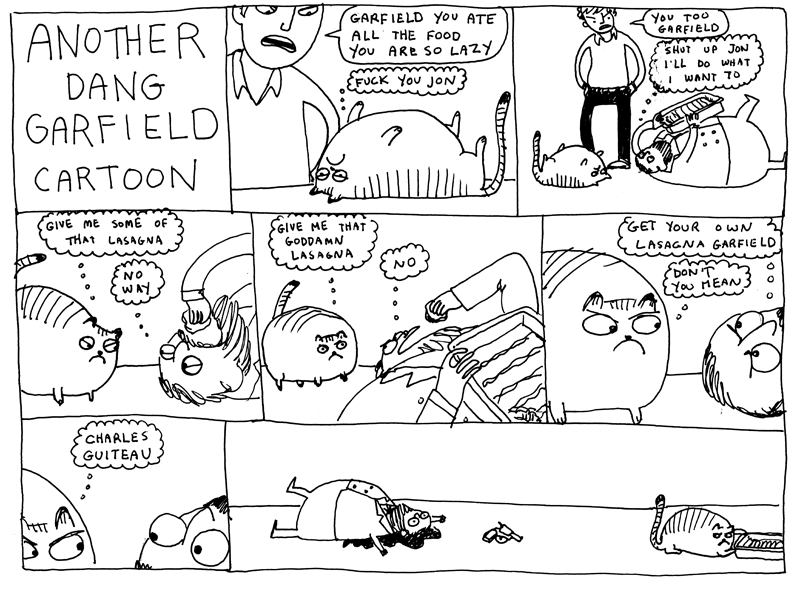
"Garfield" by Kate Beaton.
Historical reference: James A. Garfield, the 20th President of the USA, was shot and killed by Charles Guiteau.

Since January, I’ve only begun reading one more web comic: “Girls With Slingshots,” a comic about post-college graduates in a small town. It comes out daily, so I remember the narrative, and has a wide cast of characters that appeal to all types of people. The characters include S&M mistresses, roller derby lesbians, lushes, cats, baristas, computer junkies, etc. The comic is especially appealing because it shows the post-college funk, where most of the characters have jobs, but haven’t yet figured out what they want to do with their lives.

Girls with Slingshots

I’ve decided to make overcoming stupid prejudices one of my goals for the year. There were a lot of things that, after a few negative experiences, I wrote off completely, like music concerts and brussel sprouts. (I don’t hate music concerts if I can sit down and brussel sprouts are okay, but only lightly cooked and with lots of butter.) This goal isn’t really necessary to my life, but it helps break up my routine and I might end up finding something new. My next stupid prejudice ready to be overcome? Large groups of Americans mixed with beer. I am going to Oktoberfest with a group of other Fulbrighters. It's going to be awesome.