Showing posts with label children's comics. Show all posts

Sunday, September 25, 2011

“Presentación de libro de historietas hechas por niños con síndrome de down de la fundación CONTENER”


(Presentation of the comics written by kids with Down's Syndrome from the CONTENER Foundation)

I met an editor from Tinta Libre (the book’s publisher) and bought the comic Abriendo Caminos, so I was basically obligated to attend the presentation. (Federico Reggiani accuses me of buying “cualquier porquería” (crap). I don’t deny it.) Anyway, so I went expecting to hear stories worthy of a Lifetime original movie, but actually ended up enjoying the talk. The kids, clutching copies of their book and smiling, talked about their personal lives and the stories they had written. In the United States, this presentation couldn’t have occurred without the focus being on Down's Syndrome. An American version would have presented the disorder, include long speeches by the teachers, and maybe representation by the few best-behaved kids. But in this case, the authors were the stars of the show. Lucho Luna, the moderator asked the kids questions so that we, the viewers, could learn a little more about who these children were as people. Some of the kids joked about their comics, while others talked about significant others. Their happiness and pride in their achievement was notable as well as their comfort with each other and their teachers and families in the audience. The presentation focused on the kids as people, not representatives of Down's Syndrome.


The group of presenters

Responding to Lucho Luna's questions

Monday, May 16, 2011

Minute Reviews

Dante Elefante by J.J. Rovella

Colección Aventuras Dibujadas

Domus Editorial

I met J.J. Rovella while interviewing La Banda Dibujada (reflections on the interview are soon to be posted). The day after the interview, I bought Dante Elefante, a children’s comic about a blue elephant that has quite an active life—he falls in love, dies, does sports and tries to lose weight. My favorite aspect of the comic is the way Rovella recognizes the physical constraints of a comic (the panels, text bubbles, the space a comic occupies) and plays with them in a clever way. For example, Dante jumps off a diving board and is so heavy he breaks through the panel and off the page. In another scene, he sneezes while trying to read the newspaper, blowing it to pieces. After diligently taping the newspaper back together, we find that the end of the comic strip we are reading has been mis-taped and features another cartoon. Rovella creates comics acknowledging and then disregarding the limitations of a typical comic strip, challenging us as readers to think outside the panel.


The above images are from J.J. Rovella's blog. Check it out for more Dante Elefante comics!

Wednesday, November 24, 2010

Interpreting Owly: Part I

Owly makes me manic. I want to laugh, cry, and scream all at the same time. How does Owly elicit this insane reaction? Its overwhelming cuteness.

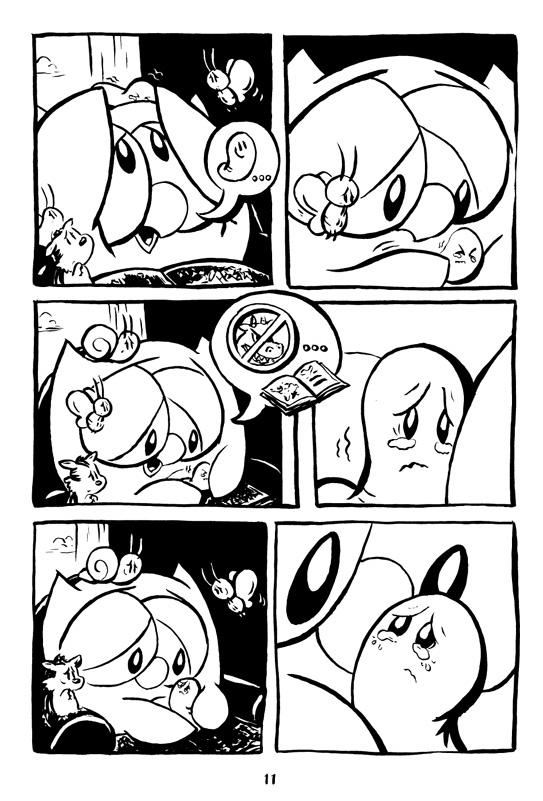
Owly deals with the trials and tribulations of flightless owl and his many forest friends. Each book has a similar plot involving a challenge, resolution, and tears. Oh, goodness, the tears. These optical emissions change the book from a cute story to an epic adventure of overwhelming proportions. They increase the level of drama by a thousand. Just look:

From Owly: A Time to Be Brave

But in all seriousness, I love Owly comics. The stories are cute, but it’s the pictorial dialogue that most interests me. All speech is communicated through pictures (see above panels). This unique style left me with a question: what is the process that a reader goes through to comprehend pictorial dialogue? I could probably write a hundred pages about this topic and not finish analyzing it. I will probably come back to this idea later, but for now I am just going to explain how I understand Owly.

When I read comics, I view words and images separately, and my attention moves between the two. Because Owly and his crew communicate in images, I don’t need to jump back and forth between text and drawings. Instead, the process becomes much more complicated. I must extract all meaning by interpreting symbols, actions, and emotions, drawing on context and prior events. An exclamation mark could indicate happiness or be a warning. Sometimes, the characters speak in intricate symbols that take a few seconds to decode. In one such scene, Owly is talking to a distressed Wormy. The first speech bubble shows an arrow pointing out an open door, followed by an exclamation point. The subsequent speech bubble shows a smiling sun equaling (with an equal sign) a smiling, happy Wormy. Now how does one interpret that image? Is it “Let’s go outside! It’ll make you feel happy!” or “If we head out the door, the bright sun will make you feel less scared!” The process of viewing makes each individual’s reading experience unique. We each find a way of translating the pictures based off how we interpret these combinations of images.

In future posts, I plan to discuss how children (the intended readers) read Owly, and the various theories on comic books and child development.